Shoot Out: Gun Shooting Games
- 4.4
- Rating
- 50.00M
- Installs
- Free
- Price
 Analysis by App-foxy
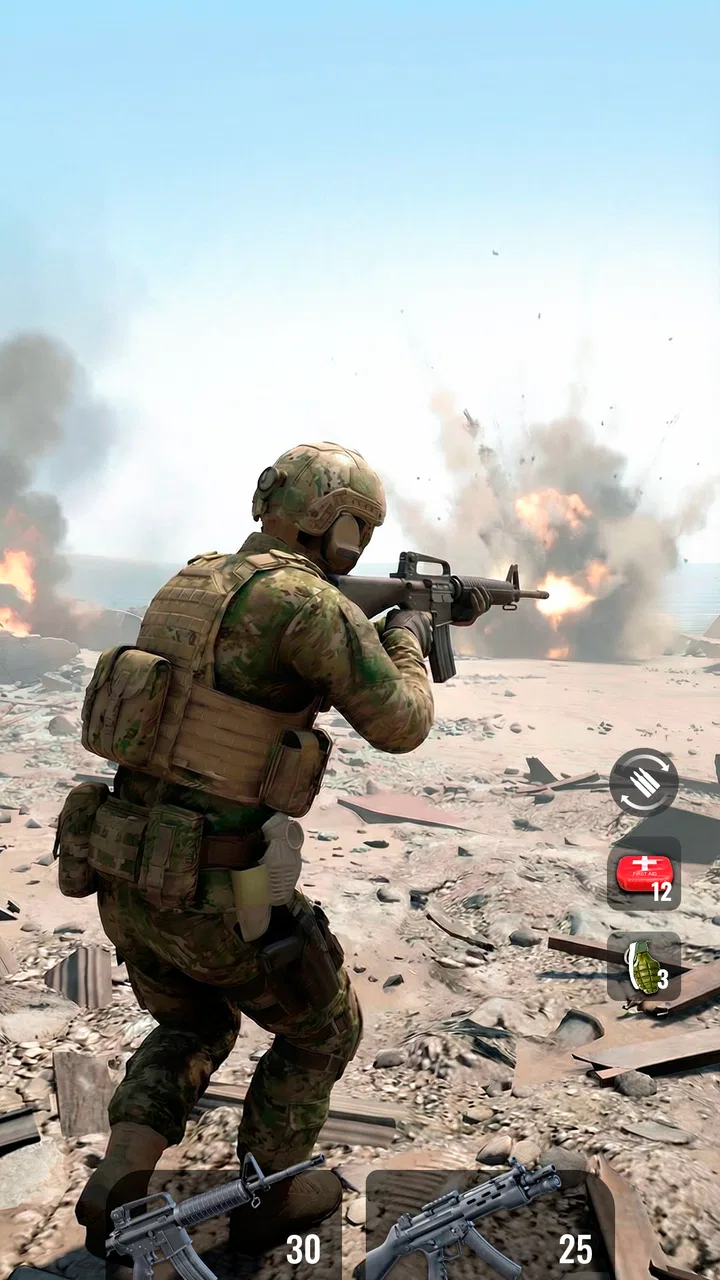
I went into Shoot Out: Gun Shooting Games expecting a quick action game, but the experience is more interesting when I treat it as a test of patience as much as aim. It combines shooting with tactical stealth missions, so rushing forward is not always the smartest move. The game is free to download, belongs to the action category, and comes from Freeplay Inc. Its mature age rating is important: this is aimed at adults, not children or players looking for a gentle arcade experience.
My main question while playing was simple: does it offer enough decision-making to stay engaging after the first few sessions? The answer depends on what I want from a mobile shooter. If I want short bursts of combat, a direct objective, and the tension of deciding when to attack, it has a clear appeal. If I want a deep competitive ecosystem, a large social community, or the precision of a console-style shooter, I would look elsewhere.
The game has reached over 50 million installs and holds a 4.4 average from around 1.2 million ratings, which suggests that its straightforward approach has found a substantial audience. Those figures do not automatically make it a perfect fit, but they do indicate that this is not an obscure experiment. I found it easiest to judge by looking at the moments that matter most: how quickly I could begin, how much control I had during missions, how well the stealth angle worked, and whether the free-to-play design interrupted the flow.
You May Also Like

 Blood Strike: 2.5 Anniversary
Blood Strike’s Loadouts Turn Every Drop Into a Tactical Gamble
A close look at Blood Strike’s custom loadouts: how fast access to signature weapons reshapes its battle royale rhythm, rewards preparation, and narrows the gap between fights.

 Pandora - Music & Podcasts
Pandora’s Music Is Easy to Start, but Harder to Recover
Pandora’s strength is its low-effort path from a seed to a station. Its weak spot is how much confidence it asks you to place in connection, setup, and quiet recovery.

 8 Ball Pool
 Is Built on Rivalries, Rematches, and Routine
A close look at the rivalries, rematches, shared routines, and unanswered safety questions that turn a quick pool match into a persistent mobile community.

 Samsung Music
’s Quiet Strength Is Playing What You Already Own
Its reach comes less from spectacle than from dependable access to a personal library. That simplicity is both the app’s strongest retention engine and its ceiling.

 AccuWeather: Weather Radar
AccuWeather Review: A Quick, Clear Forecast for Everyday Decisions
For everyday plans, the best forecast is the one you can understand quickly. AccuWeather makes rain timing, radar, and local conditions easy to act on, with a few trade-offs.

 Hill Climb Racing
Why Hill Climb Racing Still Turns Crashes Into One More Run
A tiny car, a bumpy hill and one more upgrade: Hill Climb Racing keeps resurfacing because its simple chaos makes every near-miss feel personal.
More From Our News Desk



How I Decide Whether This Shooter Is Worth Keeping
I judge whether this shooter deserves a lasting place on my phone by looking beyond the first rush: does its mix of combat and stealth still reward attention when the novelty wears off? I also consider whether I can fit it into short breaks without turning play into a spending habit. That gives me a practical way to weigh its recurring value against the kinds of fatigue that can make me move on.
The first minutes tell you what kind of player it suits
The most useful way to approach this game is not to compare it with every action title on a phone. I compare it with the specific alternatives I might choose at that moment. A fast arcade shooter should make me feel immediately powerful. A tactical game should make me think before acting. A competitive multiplayer title should reward long-term practice against human opponents. Shoot Out sits closer to the first two categories, with its strongest identity coming from the combination of shooting and stealth.
That combination changes how I play. In a purely reflex-based game, I can often recover from a careless opening by moving quickly and firing accurately. Here, the tactical side encourages me to slow down, watch the situation, and avoid turning every encounter into uncontrolled noise. The result is more satisfying when I plan well, but it can feel less exciting if I only want constant action.
I also consider whether a mobile shooter respects short sessions. This is where the game makes sense for everyday use. I can pick it up when I have a few spare minutes, play through an objective, and put it down without needing to coordinate with a team. That makes it suitable for a commute, a waiting room, or a short break at home. It is less suitable if I want a long-form campaign with a carefully developed story and a large world to explore.
Controls and attention matter more than raw speed
Mobile shooting games can become frustrating when the controls demand too much precision from a small screen. I found that the best results came from treating each encounter as a sequence of choices rather than simply dragging toward the nearest target. I paid attention to positioning, avoided unnecessary movement, and tried not to fire just because an enemy appeared on screen.
That habit is one of the less obvious strengths of the design. Even when a mission looks simple, I get more out of it by separating observation from action. I first identify what seems dangerous, then decide whether a direct shot or a quieter approach makes more sense. This is a practical tip for new players: do not judge the game after one rushed attempt. The tactical layer becomes clearer when I stop treating every level like a reaction test.
There is also a trade-off. Players who enjoy quick, forgiving controls may feel that the stealth emphasis slows the rhythm. Players who enjoy planning may wish for more room to experiment. The game gives me enough of that tension to make individual missions engaging, but it does not replace the depth of a dedicated stealth simulator.
What the free model means in practice
The game is free, which removes the biggest barrier to trying it. That is useful because the appeal is quite personal: some players will enjoy the blend of combat and caution, while others will decide within a short time that they prefer a different style of shooter. I would install it rather than buying blindly, especially if I already know I like compact action games.
There are in-app purchases ranging from under one dollar to around one hundred dollars per item. That range makes it important to decide in advance how I want to play. I would not treat optional spending as part of the basic entry requirement, but I would keep an eye on purchase prompts and avoid making a decision in the middle of a frustrating mission. The safest approach is to enjoy the free progression first and only consider spending if the game has already earned regular space on my phone.
This is another reason I would not recommend it automatically to younger players. The mature rating already places it in an adult audience, and the presence of purchases means families should consider device-level spending controls as well as the content itself. For an adult who understands the free-to-play structure, the model is easier to manage.
Where the game is strongest
Its best quality is the way it gives ordinary shooting encounters a little more tension. I do not always feel that the correct answer is to move forward immediately. The stealth framing encourages me to think about timing and exposure, which makes a successful mission feel more deliberate than a simple target gallery.
That makes it a good choice for a player who wants action without committing to a large, complicated game. I can play actively, but I can also use a more measured style. The game is particularly appealing when I want something more thoughtful than a basic tap-to-shoot experience, yet less demanding than a full competitive shooter.
Another strength is accessibility of purpose. I do not need to understand a complicated fictional universe before enjoying a mission. The central loop is easy to explain to a friend: enter a combat situation, read the threat, use aim and timing, and try to complete the objective without making poor decisions. That clarity helps the game work as a casual recommendation.
Three habits that improve the experience
My first useful habit is to separate the first attempt from the learning attempt. On an initial run, I focus on discovering how the encounter behaves instead of chasing a perfect result. Once I understand where pressure comes from, I can replay with a calmer plan. This is more effective than repeatedly restarting after every small mistake.
Second, I try to preserve attention for the final part of a mission. It is easy to relax after handling the obvious threat, but the later moments are where careless movement or hurried firing can undo a good run. I found that treating the ending as a fresh decision point helped me finish more consistently.
Third, I use short sessions intentionally. Rather than playing until I become impatient, I stop after a satisfying mission or two. That keeps the stealth tension enjoyable and prevents the repetitive side of action games from becoming too noticeable. This is especially useful on a phone, where the game competes with many other distractions.
Where another type of game may fit better
I would choose a competitive multiplayer shooter instead when my priority is human opposition, team coordination, and a long-term skill ladder. Those games are better for players who want to build a routine around matches, communicate with teammates, and measure improvement against other people. Shoot Out is a better fit when I want a self-contained session and do not want my enjoyment to depend on a team or an online opponent.
I would choose a story-driven action game when atmosphere, characters, and narrative progression matter more than compact combat. Shoot Out gives me a focused action premise, but it should not be mistaken for a cinematic adventure. Its appeal is the immediate decision in front of me, not a sprawling story that I follow over many hours.
I would also choose a pure arcade shooter when I want instant movement and uncomplicated aggression. The tactical element here is a benefit only if I am willing to use it. Someone who dislikes waiting, positioning, or reconsidering a shot may find the game less satisfying than a faster alternative.
On the other hand, dedicated stealth games may be preferable for players who want elaborate routes, extensive environmental manipulation, and multiple ways to solve every situation. Shoot Out gives stealth a meaningful place in its action formula, but I would not install it expecting the complexity of a specialist stealth title.
Who should skip it
I would skip this game if I am looking for a relaxed, family-friendly experience, because its mature rating clearly places it in an adult-oriented space. I would also skip it if I strongly dislike in-app purchase systems or know that visible offers make free games uncomfortable to use. The wide purchase range means self-control and spending limits are part of the practical decision.
It is also not my first recommendation for someone who wants a deep weapon-customization hobby, a persistent social identity, or a serious esports-style challenge. The game works best as a focused action option, not as a replacement for every other kind of shooter.
What switching to it involves
The cost of switching is low in terms of money because the game is free to start. The larger cost is attention. I need to learn how its combat and stealth balance feels, adjust to its pacing, and decide whether I enjoy repeating the process of reading an encounter before acting. If I am coming from a fast arcade shooter, the first adjustment may be learning not to waste every opportunity by firing instantly.
If I am coming from a competitive game, the switch may feel quiet. There is less pressure from a live opponent, but that also means I can play at my own pace. If I am coming from a story-heavy game, I may appreciate the directness, though I should not expect the same sense of character development or world-building.
My advice is to give it a fair trial during several short sessions rather than one long test. The first session tells me whether the controls feel natural. The next few tell me whether the stealth decisions remain interesting after the novelty fades. That distinction matters more than the initial impression, especially for a free game with a simple premise.
Technical fit and ongoing usability
The current version is 5.0.2, and the game runs on Android devices using version 6.0 or later. That makes checking the operating system a sensible step before installing, particularly on an older phone or tablet. I would also leave enough storage space for the installation and future updates, although the exact size is not something I would assume without checking the device’s store page.
Because this is a mobile action game, comfort matters. I prefer playing with a stable grip and a screen that is large enough for me to see targets without covering important areas with my fingers. A smaller display may still work, but it can make careful aiming less comfortable during longer sessions. This is not a reason to reject the game outright; it is a reason to test it in the way I actually plan to play.
Freeplay Inc has kept the concept easy to understand, which helps when recommending it to someone who does not want a complicated setup. Still, the simple premise should not be confused with unlimited variety. My interest depends on whether I continue to enjoy the rhythm of observing, aiming, moving, and choosing when to take a risk.
My recommendation after playing
I recommend Shoot Out: Gun Shooting Games to adults who want a free action title that adds tactical stealth to its shooting, especially if they prefer solo-friendly short sessions over competitive matches. The large audience and 4.4 average show that many players have found value in the formula, but I would still treat those figures as a starting signal rather than a guarantee that it matches my taste.
I would install it if I wanted something more thoughtful than a basic arcade shooter but lighter than a full stealth game. I would keep purchases optional, set a spending boundary before playing, and use the first few sessions to decide whether the tactical rhythm feels rewarding. The game is at its best when I approach each encounter with a plan instead of rushing for immediate action.
My final view is positive but specific: this is a practical recommendation for adult mobile players who enjoy compact combat and the small thrill of making the right move at the right time. It is not the right choice for children, for players seeking a narrative epic, or for anyone who wants a highly competitive online routine. If that distinction matches what I want from my phone, the free entry makes it easy to try, and the stealth-focused approach gives it a clearer personality than a standard shoot-first game.
FAQs for Shoot Out: Gun Shooting Games
01What is Shoot Out: Gun Shooting Games?
Shoot Out: Gun Shooting Games is an action-focused mobile shooter built around quick missions, target practice, and arcade-style combat. Players use different firearms to defeat enemies, complete objectives, and progress through increasingly challenging levels. The game is designed for short play sessions, making it suitable for users who want straightforward shooting gameplay rather than a complex story-driven experience.
02Is Shoot Out: Gun Shooting Games free to download and play?
The game can generally be downloaded and played without an upfront purchase, although the exact availability may depend on whether you are using Android or iOS. Like many free-to-play shooters, it may include optional advertisements, rewarded videos, or in-app purchases for upgrades, weapons, currency, or other bonuses. Check the store listing before downloading for the current pricing and purchase details.
03Does the game require an internet connection?
Some parts of Shoot Out: Gun Shooting Games may work without a permanent internet connection, especially basic shooting levels that are already installed on the device. However, advertisements, cloud features, updates, purchases, and certain events may require online access. Because requirements can change after updates, it is best to launch the game once while connected and review its permissions and in-game notices.
04Is Shoot Out: Gun Shooting Games suitable for children?
The game contains shooting, weapons, enemy combat, and action-oriented violence, so it may not be appropriate for younger children. Parents should check the age rating shown in the Google Play Store or Apple App Store, as well as the game’s advertising and purchase options. If children use the app, parental controls and purchase restrictions are recommended.
05What devices are needed to play Shoot Out: Gun Shooting Games smoothly?
Shoot Out: Gun Shooting Games is intended for modern Android and iOS smartphones and tablets, but performance can vary depending on the device, operating system, available storage, and background applications. Older phones may experience slower loading, reduced frame rates, or overheating during extended sessions. Before installing, confirm that your device meets the store’s listed requirements and has enough free space for updates.
Pros
- Fast-paced shooting matches are easy to start and play in short sessions.
- Simple controls make the game accessible to newcomers.
- Varied weapons add different play styles and combat options.
- Bright visuals and effects make battles easy to follow.
- Frequent rewards help maintain progression during regular play.
Cons
- Ads may interrupt gameplay or appear frequently between matches.
- Some upgrades can make progression feel slower without extra spending.
- Limited strategic depth may reduce long-term appeal for experienced players.
- Device performance can affect smoothness during intense firefights.
- Online features may depend heavily on a stable internet connection.

Shoot Out: Gun Shooting Games
Gallery